
Camas County Arrest Records and Court Charges
Camas County arrest records document the law-enforcement side of an event. When available from an agency, they may show the person's name, booking date, arresting agency, charge description, statute or case number, bond, court date, release status, physical description, or mugshot if the agency publishes it. The research did not locate an official Camas County online jail roster or booking database, so public users should not expect a county mugshot list or booking search.
Court charges after arrest begin when the prosecutor reviews reports and files formal counts in court. The Camas County Prosecuting Attorney is the local charging authority for county and state prosecutions. A booking allegation can differ from the final complaint or information. The formal charge record then moves through the criminal case, where it may be amended, reduced, dismissed, resolved by plea, tried, or sentenced. For the full case file and final outcome, use Camas County criminal court records.
Find Camas County Arrest Records and Charges
The charge side is searched through the Idaho iCourt Portal, because Camas County does not have a separate county case-search portal in the research sources. Search by defendant name, case number, or citation-style identifier when available. Narrow by Camas County, Fifth Judicial District, criminal case type, or date range if the portal provides those filters. If the charge is very new, the court entry may lag behind arrest or prosecutor review.
- Start with iCourt for public filed charges and court status.
- Search by case number when known, or by defendant name with Camas County filters when available.
- Open the case and read each count, severity, plea, docket event, amendment, dismissal, and disposition.
- Use the Camas County Sheriff's Office for current custody or booking questions when no public roster is posted.
- Ask the clerk for certified copies if the court charge record must be used for an official purpose.
Booking, custody, and jail status are different from the filed charge record. The research source set points users to the sheriff channel for county custody questions, the Idaho Department of Correction resident/client search for state custody or supervision, and Idaho VINELink for custody notification. A court docket can show bond or a next court date, but it is not a jail roster.
Charging Documents After Arrest
After an arrest or citation, prosecutors decide what formal charges to file. Idaho criminal records may refer to a complaint, information, or indictment. The research notes that an information is a formal criminal charging document filed by the prosecutor, while an indictment is returned by a grand jury and is uncommon in routine state cases. A complaint can be the first pleading in a criminal matter or a charging document in some cases.
| Document | Who creates it | What it does | Common use in the record |
|---|---|---|---|
| Complaint | Officer, prosecutor, or court filing party depending on case type | Starts a case or states the initial criminal accusation. | Often appears early in misdemeanor or initial criminal proceedings. |
| Information | Prosecutor | Sets out formal counts filed by the prosecuting attorney. | Common formal charging paper after prosecutor review, including felony matters after preliminary stages. |
| Indictment | Grand jury | Returns criminal charges through the grand-jury process. | Possible in serious cases but not routine in ordinary state prosecutions. |
The Idaho juvenile-record confidentiality statute is posted at Idaho Code 20-525.
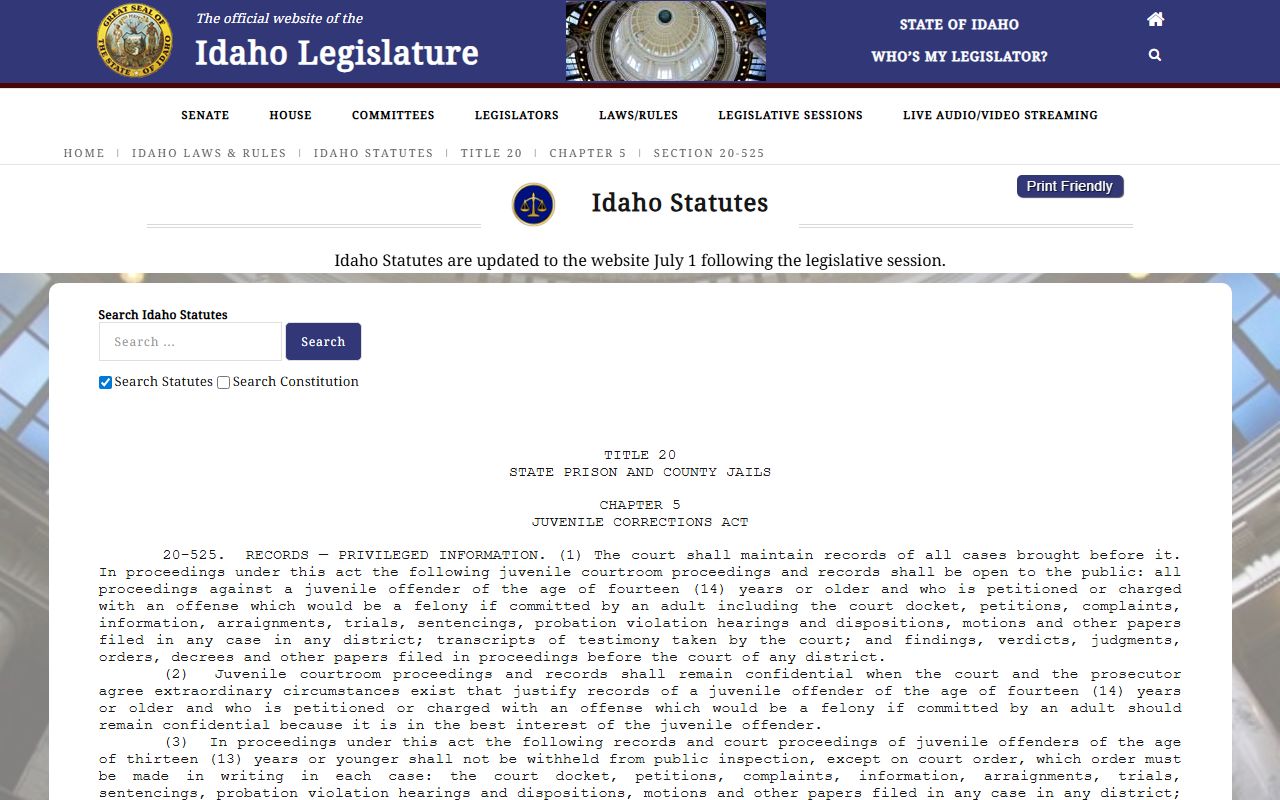
That restriction matters because juvenile arrest allegations and juvenile court charges are not ordinary public Camas County charge records.
Camas County Charge Status Terms
Charge status can change as the prosecutor reviews facts, defense issues are raised, witnesses appear, or plea negotiations occur. One arrest can lead to several counts, and each count can end differently. A charge may remain pending while the case is active, be amended to a different offense, be reduced, be dismissed, or end in a conviction. The court register should be read to the final disposition before drawing conclusions.
| Status | What It Means | How to Read It |
|---|---|---|
| Pending | The charge has not reached a final court outcome. | Check for future hearings, motions, bond terms, and plea settings. |
| Amended | The charge text, statute, count, or severity changed. | Compare later entries with the first filed charge. |
| Reduced | The charge moved to a lesser offense or lower severity. | Look for plea, agreement, or amended filing entries. |
| Dismissed | The court or prosecutor ended that count without conviction. | Confirm whether other counts in the same case remained active. |
| Convicted | The defendant was found guilty or entered a plea accepted by the court. | Read the sentence entry for jail, probation, fines, costs, and restitution. |
| Warrant / FTA event | A missed court date or order may have led to a bench warrant or related entry. | Check later recall, quash, bond, or new hearing entries. |
Camas County Charges vs Convictions
A charge is not proof that a person was convicted. It is the formal allegation or count filed in court. A conviction comes later, if the defendant pleads guilty or no contest and the court accepts it, or if a trial ends in a guilty verdict. Arrest records and court charge records should always be read with the final disposition.
| Point | Charge | Conviction |
|---|---|---|
| Legal role | Accusation filed after law-enforcement and prosecutor review. | Final guilt outcome after plea or verdict. |
| Timing | Early in the court case and subject to change. | After the court accepts or enters guilt. |
| Possible paths | Pending, amended, reduced, dismissed, or resolved. | Can lead to sentence, probation, fines, restitution, and court costs. |
| Record reading | Do not treat as the final outcome. | Read with sentence and post-judgment entries. |
Fields in Camas County Charge Records
Filed charge records can include several fields that sound similar but do different work. A case number points to the overall criminal matter. A count number identifies one alleged offense within that case. An offense description gives a plain-language label. A statute ties the count to Idaho law. Severity can identify felony, misdemeanor, or infraction handling. Plea, disposition, and sentence fields show how the count moved after filing.
- Offense description: the charge label shown in the public case record.
- Statute or code: the Idaho legal citation or offense reference tied to the count when public.
- Severity: felony, misdemeanor, or infraction level where the record provides it.
- Bond: money or release conditions tied to custody or appearance where public.
- Plea and disposition: the defendant response and the final result of the count.
- Sentence and financials: jail, probation, fines, costs, restitution, payment plan, or balance when public.
State Criminal History and Charge Records
The Idaho State Police criminal history portal is a statewide criminal-history channel. It is not the same as the Camas County court case register. Idaho Code 67-3004 controls dissemination of criminal-history record information, while court access rules control what appears in court records. A court charge can be visible in iCourt even when a state background response has a different scope, timing, or eligibility rule.
Use the right source for the question. For filed counts and case outcome, search iCourt and ask the clerk for copies. For custody or booking facts, use sheriff, IDOC, or VINELink channels. For statewide criminal-history dissemination, use the Idaho State Police route. For sex-offender registration, use the Idaho State Police registry, which is not a court charge database.
Sealed vs Expunged Charge Records
Idaho restrictions can affect charge records in more than one system. A sealed court case may not appear in public iCourt. A juvenile matter may be confidential under Idaho law. Expungement or shielding can limit public access or dissemination when a statute and order allow it. The safest approach is to identify whether the record is a court charge, criminal-history entry, sheriff booking record, or driver record before seeking relief.
| Point | Sealed | Expunged or Shielded |
|---|---|---|
| Public search | May show no result or only limited information. | Access or dissemination may be limited by the order and applicable Idaho law. |
| Scope | Usually tied to a case, document, or category protected by rule or order. | Depends on eligibility and the exact relief granted. |
| Agency records | Some nonpublic agency access may remain. | Other systems may need separate handling. |
| First step | Find the court and case number if possible. | Confirm whether the issue is court access, ISP dissemination, sheriff booking, or another record. |
Restricted Camas County Charge Records
Restricted Camas County charge records include juvenile matters, sealed cases, protected-person records, mental-health-related material, adoption-related material, financial identifiers, Social Security numbers, and some active investigation details. Search warrants before return and confidential law-enforcement material may also be unavailable to the public. Public iCourt may hide the record, redact fields, or show a limited register.
For unresolved warrants or missed court dates tied to a charge, search the related case in iCourt and contact the court or sheriff rather than relying on unofficial lists. No official Camas County active-warrant search page was located in the source sweep. If a warrant or arrest is possible, an attorney can help plan bond, surrender, recall, or quash questions before the person contacts law enforcement.